


How to Sell a House in Aldie VA: A 2027 Guide for Homeowners

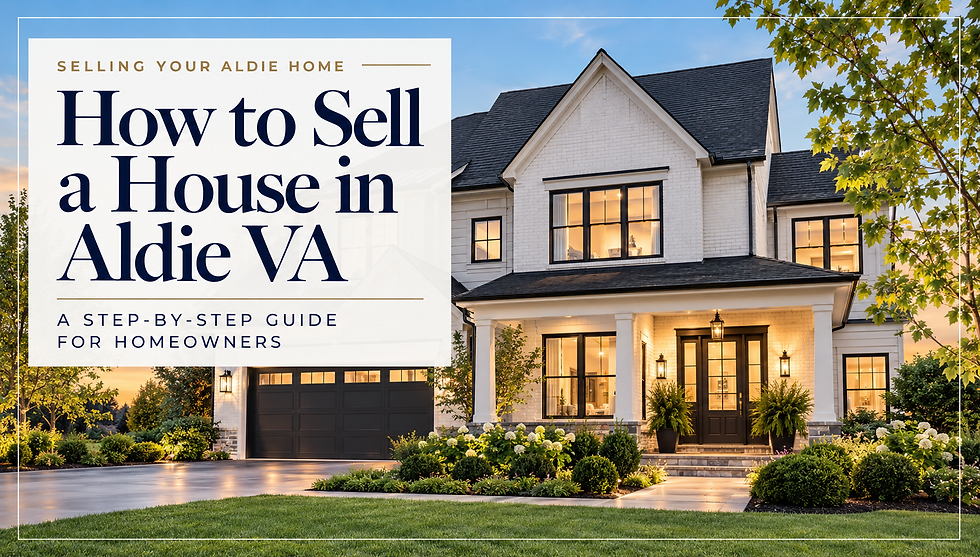
If you're thinking about selling your home in Aldie, Virginia, you may already be wondering where to start.
Should you renovate first? How do you determine the right asking price? When should you contact a Realtor? How much will it cost to sell? And perhaps most importantly, how much could you actually walk away with after the sale?
Selling a house in Aldie isn't simply a matter of putting it in the MLS and waiting for buyers.
Aldie includes newer construction, established planned communities, luxury properties, townhomes, homes on larger lots and everything in between. Buyers comparing homes in the 20105 ZIP code also have access to nearby communities such as South Riding, Stone Ridge and Brambleton.
That means your home has to compete.
As an Aldie resident and local real estate agent, I closely follow what's happening in the 20105 market—from new listings and price reductions to contracts, closed sales and seller concessions.
If you're wondering how to sell a house in Aldie VA, here's how I would start preparing now.
How to Sell a House in Aldie VA in Today's Market
The first thing to understand is that there is no single "Aldie market."
What's happening with a million-dollar single-family home may be very different from what's happening with an entry-level townhome. Even two similarly sized houses can perform differently based on neighborhood, condition, lot, upgrades and competition.
That's why broad statistics about Loudoun County aren't enough to develop a pricing strategy for an individual property.
Before selling your home, I want to know:
- What has recently sold near your home?
- What's currently competing with it?
- Which homes are going under contract?
- Which listings are sitting?
- Which sellers have reduced their prices?
- Are buyers receiving closing-cost assistance or other concessions?
- Are contracts making it all the way to closing?
- What does your home offer that the competition doesn't?
That last question is particularly important.
Buyers don't evaluate your house in isolation. They compare it with everything else they can buy for roughly the same amount of money.
Step 1: Determine What Your Aldie Home Is Worth
One of the first questions almost every seller asks is:
"How much is my house worth?"
Online estimates can be interesting starting points, but they don't know your house the way a buyer will experience it.
They don't necessarily know that you've remodeled the kitchen, replaced major systems, have a premium lot, finished the basement or haven't updated the primary bathroom since the home was built.
A strong pricing analysis should consider recent comparable sales, but it shouldn't stop there.
Pricing an Aldie Home Requires Looking at Today's Competition
Sold properties tell us what buyers have paid.
Active listings tell us what buyers can choose today.
Pending homes can provide clues about which properties are actually attracting buyers.
I look at all three.
If there are several comparable homes available when yours enters the market, your pricing and presentation have to make sense relative to those choices.
That's why the question isn't simply:
"What did my neighbor's house sell for?"
It's also:
"What will a buyer see immediately before and after they see mine?"
That is the market your house actually has to win.
Step 2: Figure Out What You Could Walk Away With
Sale price gets most of the attention, but it's not necessarily the number that matters most.
Your net proceeds are.
Your mortgage payoff, real estate compensation, settlement expenses, taxes, HOA-related costs, negotiated buyer concessions and other expenses can all affect what remains after closing.
Before making major decisions about your next home—or deciding how much money to spend preparing your current one—I think sellers should have an idea of their potential bottom line.
What Could You Walk Away With From Your Aldie Home Sale?
I've created an Aldie Home Seller Net Proceeds Calculator that lets you estimate your potential proceeds based on your expected sale price and selling expenses.

Step 3: Decide What to Fix Before Selling Your Aldie Home
This is where sellers can waste a lot of money.
Not everything that bothers you about your house needs to be fixed before you sell it.
And not every improvement will return what you spend.
Before investing thousands of dollars in renovations, I would separate potential projects into three categories:
Things that could make buyers question the home's condition. Active leaks, obvious damage, broken fixtures and deferred maintenance deserve attention.
Relatively inexpensive improvements that improve presentation. Fresh paint, landscaping, lighting, cleaning and minor cosmetic repairs can sometimes make a significant visual difference.
Major renovations that may not make financial sense before selling. A seller shouldn't automatically spend $50,000 remodeling a kitchen because someone told them updated kitchens sell houses.
The question is always:
Will doing this work improve the likely outcome enough to justify the cost, time and inconvenience?
Sometimes the answer is yes.
Sometimes I would tell you to clean it, stage it and leave it alone.
Can You Sell a House As-Is in Aldie VA?
Absolutely.
"As-is" doesn't necessarily mean distressed. It simply means the seller isn't planning to make certain repairs or improvements.
The tradeoff is that buyers will evaluate the property's condition when deciding what they're willing to pay.
A good selling strategy should compare the likely return from improving the property against the likely return from selling it in its current condition.
That decision should be based on numbers, not fear that everything has to be perfect.
Step 4: Prepare Your Home for the Market
Once we've decided what not to spend money on, we can focus on what actually matters.
For most sellers, preparation includes some combination of decluttering, deep cleaning, touching up paint, addressing obvious maintenance issues, improving curb appeal and preparing the home for professional photography.
This is also when I want sellers to begin emotionally separating living in the house from selling the house.
The goal isn't to erase every sign that a family lives there.
It's to make it easy for buyers to picture themselves living there next.
Decluttering Before Selling Your Aldie Home
You don't have to empty the house.
But you do want buyers noticing the home's space, light, layout and features—not the amount of stuff inside it.
Start earlier than you think you need to.
Closets, garages, basements and storage areas tend to take longer than expected, and buyers absolutely open closet doors.
If you're planning a 2027 move, decluttering is one of the best projects to begin months before you intend to list because it costs very little and makes the eventual move easier too.
Step 5: Price Your Aldie Home for the Market You're Actually In
Pricing is strategy.
It isn't a compliment to your home, a judgment about what you've invested in it or a promise about what you'll ultimately receive.
The list price is a marketing decision.
A common temptation is to price high "just to see what happens."
What happens can be expensive.
The initial period after a listing launches is when it has the greatest novelty. Buyers who have been waiting for something in your price range will see it. Agents will send it to clients. Online portals will identify it as new inventory.
If those buyers decide the price doesn't make sense, you've used part of your strongest marketing window.
Should You Price High and Leave Room to Negotiate?
There isn't one answer for every house.
A truly unusual property with few comparable sales may require a different strategy from a home in a neighborhood with several recent sales.
But I don't believe in choosing a price simply because it gives us "room."
I'd rather know why we're pricing where we're pricing and what market response we expect to see.
Then we watch the data.
Are buyers clicking?
Are they saving the listing?
Are agents scheduling showings?
Are buyers returning for second visits?
Are we receiving offers?
If the market isn't responding as expected, that's information—not something to ignore for six weeks.
Step 6: Market the Home, Not Just the Listing
Professional photography matters.
So does presentation.
But effective real estate marketing should answer a larger question:
Why should someone choose this particular home?
Perhaps it's the lot.
Perhaps it's a beautifully finished basement.
Maybe it's outdoor living, a renovated kitchen, a home office, multigenerational space or proximity to something buyers value.
Every home has a story.
The marketing should identify it.
Marketing a Home for Sale in Aldie VA
A strong launch can include professional photography, compelling listing copy, digital marketing, social media, agent-to-agent exposure and distribution through the MLS and consumer real estate sites.
For certain properties, video, aerial photography or other enhanced marketing may also make sense.
But more marketing isn't automatically better marketing.
The objective is to reach the people most likely to value what your home offers and give them a compelling reason to see it.
Step 7: Make Your Home Easy for Buyers to See
This one isn't glamorous, but it matters.
If possible, make showing the house relatively easy.
A buyer who can't see your home may simply see another one.
That doesn't mean sellers have to accept unreasonable showing requests or turn their lives upside down indefinitely.
It means we create a showing strategy before listing so everyone knows what to expect.
And yes, keeping a house show-ready can be exhausting.
Fortunately, the goal is not to live that way forever.
The goal is to maximize your opportunities while your home is actively competing for buyers.
Step 8: Evaluate the Entire Offer—Not Just the Price
Imagine receiving two offers.
One is slightly higher but includes more contingencies, substantial closing-cost assistance and financing that presents additional uncertainty.
The other is slightly lower but has stronger terms.
Which is better?
You can't answer from the purchase price alone.
When reviewing an offer, sellers should consider factors including:
- Offer price
- Financing
- Down payment
- Earnest money deposit
- Requested seller concessions
- Inspection terms
- Appraisal terms
- Settlement date
- Home-sale contingencies
- Other conditions affecting the likelihood of closing
The strongest offer is the one that best accomplishes your priorities, and those priorities aren't identical for every seller.
Someone relocating on a firm date may value certainty differently from a seller with complete flexibility.
Step 9: Get Through Inspection, Appraisal and Financing
Going under contract isn't the finish line.
Depending on the terms of the contract, there may still be an inspection, appraisal, financing and other contingencies to navigate before closing.
This is where experienced representation matters enormously.
Problems don't always mean a transaction is falling apart.
The job is to understand the issue, evaluate the options and negotiate toward the seller's objective.
What Happens if the Home Doesn't Appraise?
If the buyer is financing the purchase, the lender may require an appraisal.
If the appraisal comes in below the contract price, what happens next depends on the contract terms.
Possible outcomes can include the buyer bringing additional cash, the parties renegotiating the price, challenging the appraisal where appropriate or another solution permitted under the contract.
This is another reason the highest offer isn't automatically the strongest offer.
The terms matter.
Step 10: Prepare for Closing
As settlement approaches, your title or settlement company coordinates the final paperwork, mortgage payoff and transfer of ownership.
You'll also need to coordinate practical details such as moving, utilities, keys and any contractual requirements regarding the property's condition at settlement.
The buyer will typically conduct a final walkthrough shortly before closing.
Then the documents are signed, ownership transfers and your net proceeds are distributed according to the settlement process.
And yes—that's when all those months of preparation finally become real.
Planning to Sell Your Aldie Home in 2027? Start Now.
If 2027 is when you think you may sell, you are not too early.
In fact, this is my favorite time to start working with a future seller.
There is no pressure to get the house photographed next week. We have time to make thoughtful decisions.
We can walk through the property and identify what deserves attention.
We can separate projects worth considering from projects I wouldn't spend money on.
You can declutter gradually.
We can begin watching comparable properties.
You can estimate your potential proceeds.
And we can work backward from the time you'd ideally like to move.
When Should You Contact a Realtor if You Want to Sell in 2027?
You don't need to wait until you're ready to list.
I'd rather meet with you six months too early than six days too late.
An early conversation doesn't commit you to selling. It gives you information.
And information gives you options.
If you're considering selling your Aldie home in spring or summer 2027, fall 2026 is an excellent time to start developing the plan.

Selling in 2027? Start With a Plan.
Get my 2027 Home Seller Checklist to see what you can begin doing now—and what can wait.
Common Mistakes to Avoid When Selling a Home in Aldie VA
Several seller mistakes are particularly avoidable.
Overpricing because you "need" a certain number. Buyers don't know what you need to net. They compare your home with their alternatives.
Renovating without first considering the return. Don't automatically spend money simply because you're preparing to sell.
Waiting until the last minute to prepare. Even small projects become stressful when everything has to happen at once.
Ignoring the competition. Your home isn't competing with what sold eight months ago. It's competing with what buyers can choose now.
Focusing only on offer price. Terms and likelihood of closing matter.
Assuming going under contract means the deal is done. Inspection, appraisal and financing can still matter after ratification.
Choosing an agent based only on the suggested list price. A higher suggested price doesn't necessarily produce a higher sale price.
How to Choose a Realtor to Sell Your Aldie Home
Your listing agent should be able to explain the strategy behind the recommendations being made.
Ask how the price was determined.
Ask what you're competing against.
Ask how the home will be positioned.
Ask what happens if buyers don't respond as expected.
Ask how offers will be evaluated.
And ask how frequently you'll hear from the agent once you're on the market.
I've written an entire guide on this subject:
Frequently Asked Questions About Selling a House in Aldie VA
How do I sell a house in Aldie VA?
Start by understanding your home's likely market value and current competition. From there, determine what preparation makes financial sense, develop a pricing and marketing strategy, launch the property, evaluate offers and navigate the contract through inspection, appraisal, financing and settlement.
When should I start preparing my Aldie home to sell?
Several months before your anticipated move is ideal if you have that luxury. Starting early gives you time to declutter, address maintenance, evaluate potential improvements and make decisions without rushing.
Do I need to renovate before selling my house in Aldie?
Not necessarily. Some improvements may increase a home's appeal or marketability, while others may not return enough to justify their cost. Evaluate proposed renovations in the context of your home's condition, competition, likely buyer and expected return before spending the money.
Can I sell my Aldie home as-is?
Yes. A property can be marketed without completing major repairs or renovations. Buyers will consider its condition when determining what they're willing to pay, so the decision should be part of your pricing and net-proceeds strategy.
How much does it cost to sell a house in Aldie VA?
Selling expenses vary by transaction and can include real estate compensation, taxes, settlement expenses, HOA-related costs, mortgage payoff amounts and seller concessions negotiated as part of the contract. Rather than relying on a generic percentage, calculate an estimated seller net sheet based on your specific circumstances.
How long does it take to sell a house in Aldie VA?
There isn't one reliable timeline for every property. Current public listings show Aldie homes averaging roughly a month on the market, but an individual home's timing depends on price, property type, condition, location, competition and market conditions.
Should I wait until 2027 to contact a Realtor if I plan to sell next year?
No. An earlier conversation can help you identify worthwhile repairs, avoid unnecessary projects, understand your potential proceeds and develop a timeline. You don't have to be ready to list to start planning.
Ready to Start Planning Your Aldie Home Sale?
Selling a home is a financial decision, but it's also usually connected to something larger.
Maybe you're moving up.
Maybe you're downsizing.
Maybe work is taking you somewhere else.
Maybe the house simply doesn't fit the next chapter anymore.
Whatever the reason, I believe the best selling decisions start with good information and enough time to use it.
I live in Aldie, I work in this market, and I pay close attention to what's happening in 20105—not only when I have a home to sell, but week after week.
If you're considering selling your Aldie home in 2027, we can start with a conversation about your property, your timeline and what you want the sale to accomplish.
No sign in the yard required.



Comments